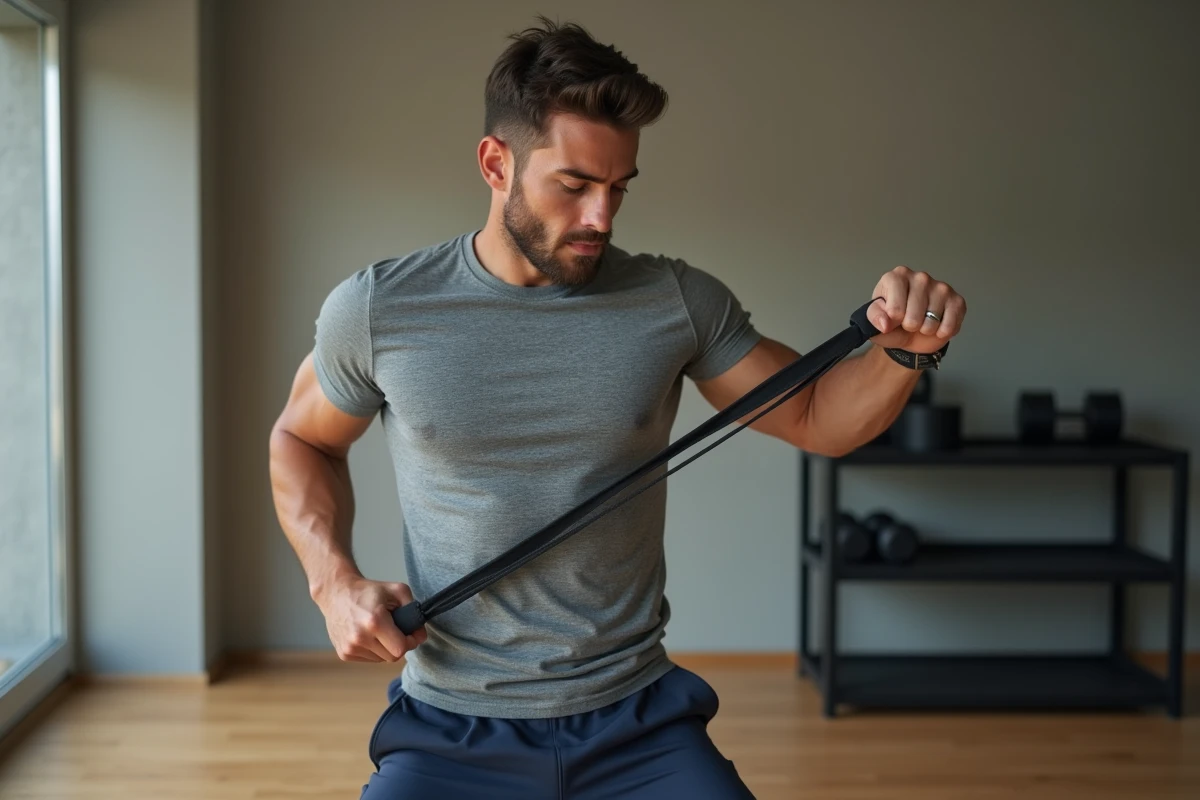
Fitness bands are not just for rehabilitation or warming up. Several studies show that they can lead to muscle gains comparable to those of free weights, provided they are used with appropriate resistance and a structured progression.
Their effectiveness depends on the choice of exercises, control of tension, and rigorous planning. Common mistakes, such as reduced range of motion or lack of progressive overload, limit their potential. Despite their apparent simplicity, elastic bands require precise technique to maximize muscle development.
Why are fitness bands effective for muscle gain?
If elastic bands have become a staple in muscle training in recent years, it’s no coincidence. Their strength? Offering progressive resistance: the tension increases as you move through the exercise. As a result, the muscle works to its fullest, where dumbbells or bars sometimes lose intensity. The tension never drops, which pushes the muscle to exceed itself in every phase of the exercise, a solid advantage for muscle gain.
With a strength band, the difficulty is easily adjusted: just change the length, thickness, or color. This equipment adapts to everyone, from beginners to experts. The different resistances allow you to target each muscle and fine-tune the effort. Compared to free weights or machines, the band has an extra card: it reduces the risk of injury by modulating resistance throughout the movement.
Resistance training with bands engages multiple muscle groups. A simple pull, for example, works the back, biceps, and core stability. This versatility accelerates overall muscle strengthening. By varying the resistance or angle, it’s possible to break out of the routine and boost muscle gain at home, without bulky equipment.
Those who wish to gain mass with Free Sport find in bands a modern and effective solution, far from the rigid codes of the traditional gym. Expert advice and the wide range of exercises offered open the door to clear and concrete progression, measurable over time.
Discover essential exercises for building muscle with bands
You can’t overlook the diversity offered by elastic exercises: this equipment fits into all muscle gain programs. The bands target every group, from the upper body to the legs, without neglecting the core or posture. To make the most of progressive resistance, it’s important to choose suitable and effective movements. Here are some key examples to integrate.
- For the upper body, include curls and extensions for the biceps and triceps, presses or flys for the chest, and vary raises for the shoulders. The back can be strengthened with horizontal or vertical pulls, provided the band is securely anchored.
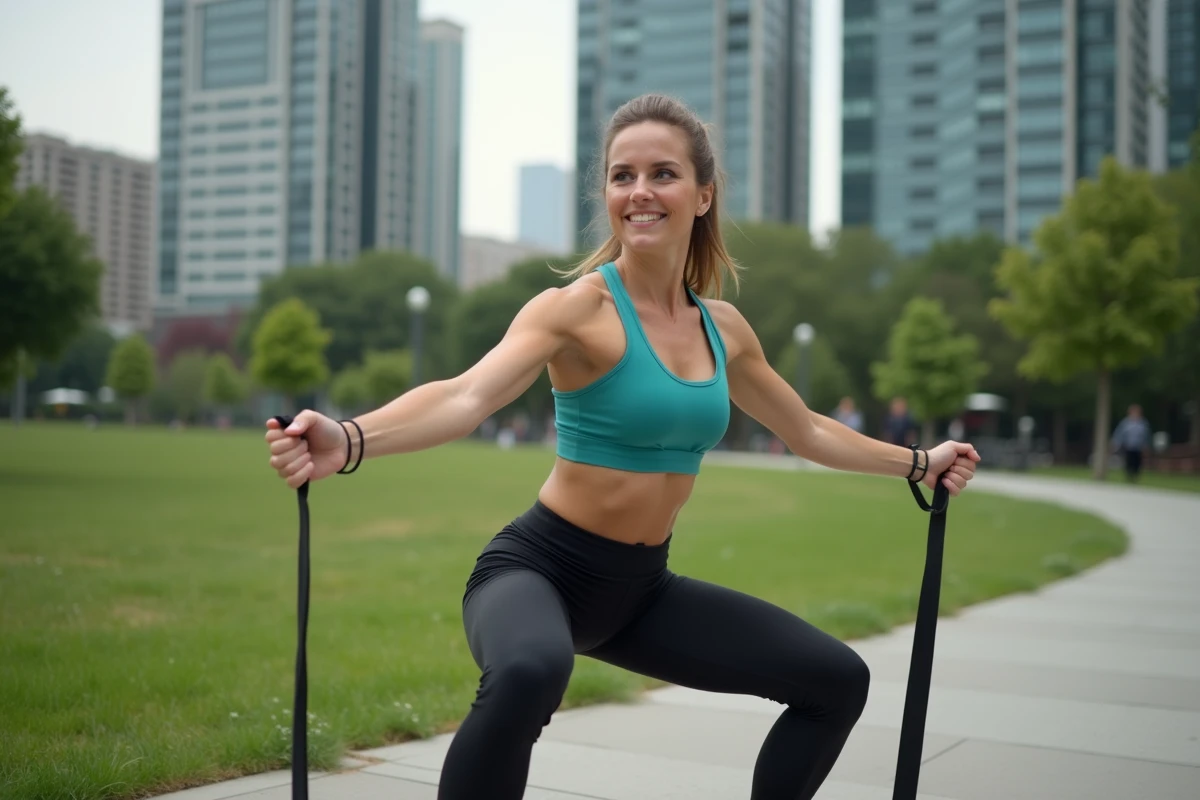
- For the lower body, focus on elastic squats, lunges, hip extensions, or abductions that target the quadriceps, hamstrings, and glutes. Adding ankle straps multiplies the possibilities.
- For the abdominal belt, think of Russian twists, resistance crunches, or dynamic planks to strengthen the core.
A complete elastic kit, with handles, a detachable bar, straps, and door anchors, expands the range of movements. This modularity allows for easy transitions from compound exercises to precise isolation work, depending on your current goals. Progress is measured by gradually increasing tension or the difficulty of movements. Training becomes flexible: at home or on the go, it remains possible to intensify your muscle strengthening without relying on any gym, while varying the pleasures and keeping safety in focus.
Practical tips for starting and progressing smoothly with elastic bands
Before each effort, take a few minutes for a warm-up. Mobilize your joints, activate circulation, prepare your muscles and tendons: resistance training with elastic bands engages the whole body and requires a good dose of vigilance, especially regarding safety. Always inspect your bands before use. A weakened or damaged band can snap unexpectedly and cause injuries that hinder progress.
Choose the resistance based on the muscle being worked and your current level. There’s no need to pull hard right from the start: the precision of the movement, the quality of the contraction, and consistency contribute much more to progress than brute strength. A progressive strength training program builds solid results without exhaustion. Increase tension or the number of repetitions step by step, and note your sessions in a training journal to visualize your concrete progress.
Allow time for recovery. Muscles develop during rest, not just during effort. Stay hydrated, adjust your meals to your goals, and regularly refresh your exercise routine. Adding new movements reignites motivation and prevents progress from stagnating.
Finally, don’t hesitate to share your journey and feedback with the community. Exchanges among practitioners are full of tips and experiences. Many notice gains in strength, better tone, or a more sculpted physique. This collective support maintains motivation and encourages you to refine your training, session after session.
Bands taut, mind alert: transformation relies on consistency, listening to the body, and the desire to progress, stretched like a band ready to unleash its full power.