
Bridge engineering is a technical feat where understanding the forces at play is fundamental. These structures, vital for transportation and connectivity, are subjected to multiple stresses. Compression and tension affect the ability of bridges to support vertical loads, while bending comes into play when these loads vary or shift. Shear is related to horizontal forces that attempt to deform the bridge components, and torsion results from asymmetrically applied loads, tending to twist the structure. Each bridge is a case study on how these forces interact.
The fundamental forces in civil engineering: compression, tension, bending, shear, and torsion
The stability of bridges relies on mastering the fundamental forces of civil engineering. The compression force is the force that pushes the elements of the structure against each other, aiming to reduce their volume. This force is crucial in columns and arches, where it channels the weight of loads to the foundations. Conversely, the tension force stretches materials and is often counterbalanced by the use of cables or steel rods, materials known for their resistance to this stress.
The bending force comes into play when the bridge bends under the weight of moving loads, such as vehicles. This force is particularly relevant for beam bridges, where the distribution of loads must occur in a balanced manner to avoid deformations. Regarding the shear force, it acts parallel to the elements of the bridge, stressing the joints and connection points, requiring careful design to prevent any structural failure.
The different types of stress applied to bridges also include the torsion force, a complex force that can induce excessive deformations in the case of asymmetric loads. This phenomenon is particularly monitored in suspension and cable-stayed bridges, where the balance of tensions is vital. Steel, due to its robustness, proves to be a significant ally in resisting torsion, often integrated into load-bearing elements for its ability to withstand such stresses.
The structural design of a bridge must incorporate a rigorous analysis of these forces. Pre-stressing, for example, is a technique that gives structures increased resistance by applying a prior tension to certain elements. This method helps to reduce the adverse effects of bending and torsion, thus ensuring greater longevity for the bridge.
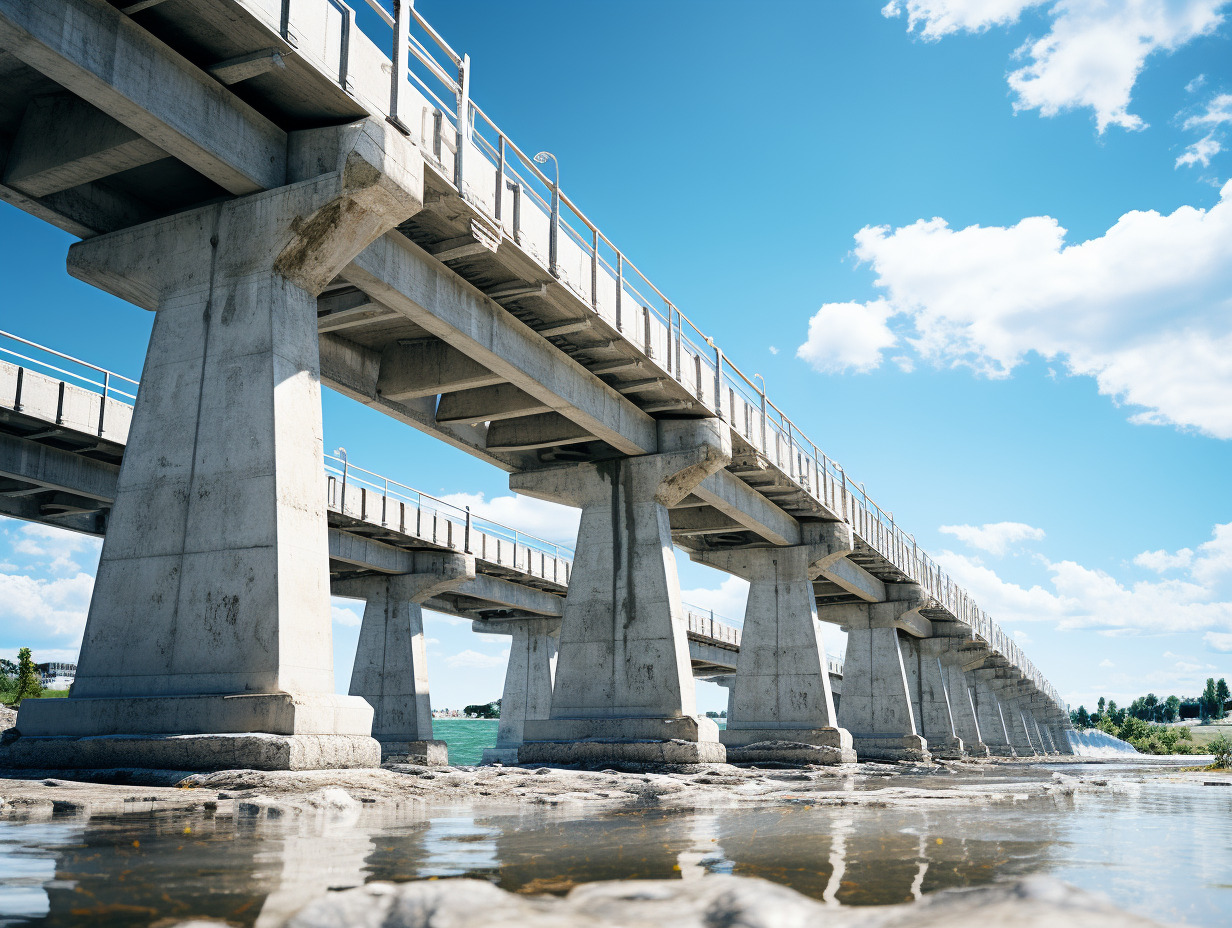
Detailed analysis of stresses on bridges and their impact on structural design
The strength of a bridge, its ability to support the forces applied to it, is a central issue in structural design. Each bridge is subjected to compression forces that press its components against each other. This action, inherent to gravity and the load of traffic, requires materials and architectural shapes capable of diffusing these forces to the foundations. Vaults and arches, inherited from ancient civil engineering, continue to prove their effectiveness in this regard.
The tension force acts in the opposite direction, pulling the elements of the structure. Suspension bridges perfectly illustrate the response to this force through the use of steel cables designed to withstand enormous tensions. Such materials are chosen for their propensity to resist without undergoing irreversible deformation, thus ensuring the long-term integrity of the structure.
The bending force, in turn, is a direct consequence of the dynamic load on bridges, particularly road traffic. Reinforced concrete beams and slabs are frequently used to absorb this force, with their design focused on distributing weight and minimizing curvature. Truss bridges, with their particular geometry, also provide an adequate response to bending by creating an interconnected network of supports that effectively distributes loads.
The shear force and the torsion force represent complex challenges for engineers. The former can cause sudden failures if the connection points are not sufficiently reinforced. The latter, often underestimated, can lead to critical deformations, especially in asymmetric structures where loads are not evenly distributed. The use of steel, notorious for its strength in torsion, and the integration of techniques such as pre-stressing are responses to these challenges, aiming to prepare the structure to withstand unforeseen or unequal loads. These methods, at the heart of modern bridge engineering, allow for the design of structures that are not only aesthetic but also capable of enduring the ages.