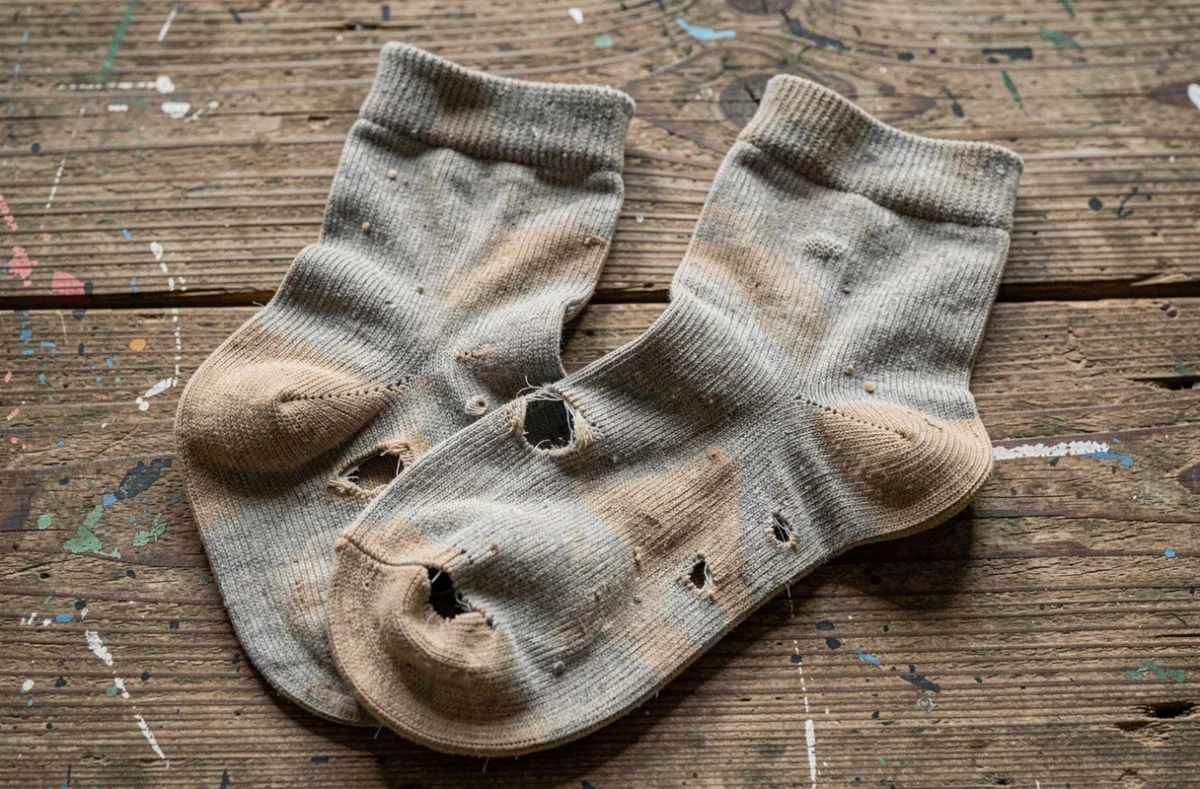
A sock with a hole in the heel does not necessarily belong in the household trash. The French textile sector, led by Refashion, accepts very worn textiles as long as they are clean, dry, and placed in a closed bag. The trash reflex, still predominant, deprives the collection circuit of usable volumes for recycling or energy recovery.
Textile composition of socks and impact on sorting
The blend of fibers dictates the fate of a sock at the end of its life. A pair made primarily of cotton with a percentage of elastane and polyamide poses a concrete problem for sorting centers: these materials do not separate easily through mechanical or chemical means.
Refashion emphasizes that recyclability must be anticipated from the design stage, by limiting material blends and elements that disrupt dismantling. For a sock, this means that the proportion of elastane is as important as the visible condition of the textile.
We recommend checking the composition label before deciding on the end-of-life circuit. A sock made of pure cotton or wool with very little elastane is more likely to be directed towards material recycling than a technical model stuffed with mixed synthetic fibers. In practice, most socks sold today combine three to four fibers, which directs them towards energy recovery rather than fiber-to-fiber recycling.
To delve deeper into the issue of the life cycle of everyday textiles, you can discover the content from Michelle Dastier on the subject.
Technical criteria for discarding or depositing worn socks
The question is not limited to the visible hole. A sock whose elastic at the cuff is dead, whose fabric has thinned to the point of becoming translucent, or whose fibers are massively pilling has reached its functional end of life.

We observe three distinct wear thresholds:
- Surface wear: pilling is pronounced, the fabric has lost its initial density, but the structure remains intact. The sock can still be worn as a base layer or for work.
- Structural wear: hole at the heel or toes, stretched ankle elastic, broken toe seam. The sock no longer fulfills its mechanical role (support, protection, thermal regulation).
- Terminal wear: transparent fabric, multiple perforations, persistent odor despite washing. No residual function.
In all three cases, depositing in a textile bin remains possible as long as the sock is dry and clean. Moisture is an operational refusal criterion: wet or moldy socks contaminate the entire collection bag and can degrade other textiles deposited in the bin.
Textile bin, trash can, or waste disposal: the right sorting circuit
The most common reflex is to put old socks in the household trash bin. This action is not unreasonable, but it bypasses a system that also handles non-reusable textiles.
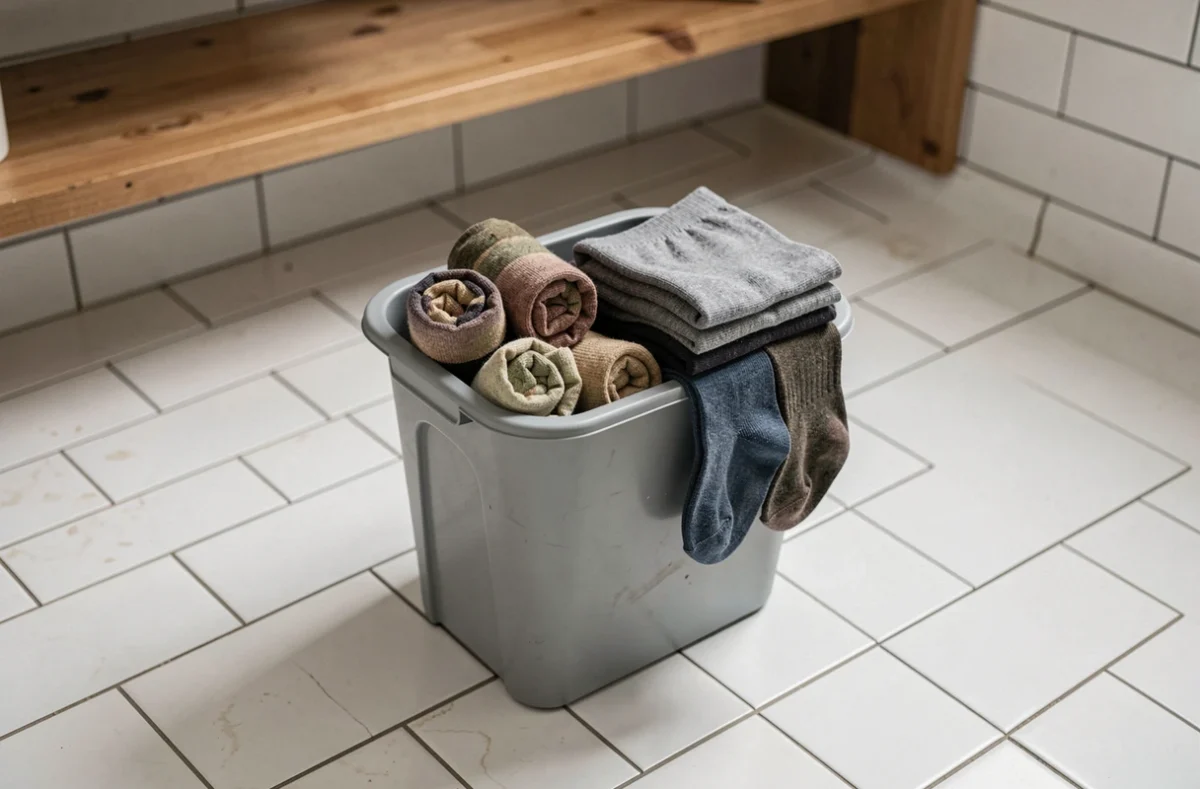
The Refashion sector directs collected textiles towards three outlets: reuse for items still wearable, material recycling for usable fibers, and energy recovery for the rest. Even an irrecoverable sock has its place in the bin, provided the deposit instructions are followed.
The deposit protocol is simple:
- Wash and dry the socks, even if they are torn or misshapen.
- Place them in a closed bag (not loose) to avoid dispersion and contamination from external moisture.
- Deposit the bag in a textile bin or return it during a collection organized by the municipality.
The regular trash can remains the default circuit only if the socks are soiled with chemical substances, paint, or hydrocarbons. In this specific case, they are not accepted in the bin.
Pressure on the sector and limits of sock recycling
The French textile sector is facing recent pressure on processing capacity. The volume of collected textiles is increasing, but industrial outlets for recycling are not keeping pace, particularly for items with complex compositions like socks.
Fiber-to-fiber recycling of socks remains marginal. The almost systematic presence of elastane, even in small proportions, complicates the fiber separation process. Sorting centers therefore direct the majority of worn socks towards energy recovery or industrial wiping cloths.
This reality should not discourage deposits in the bin. Even directed towards energy recovery, a sock collected through the textile sector avoids landfill and contributes to energy production. The environmental balance remains more favorable than direct disposal via household waste.
Extending the lifespan before discarding socks
Delaying the sorting moment starts with washing. A low-temperature cycle, with socks turned inside out, preserves surface fibers and limits pilling. The high-temperature dryer is the primary factor in accelerated degradation of elastane.
Air drying doubles the functional lifespan of most blended cotton socks. We find that users who consistently put their socks in the dryer replace them significantly more often.
Repair remains an underestimated option. A localized hole at the heel or toe can be mended in a few minutes with a standard stitch. The technique of darning, fallen out of favor, allows for extending the use of several months for a sock whose overall structure remains sound.
The choice at purchase also conditions the end of life. A sock made of predominantly natural fibers, with a limited elastane content, will be easier to recycle and more durable than an ultra-technical model made of five different fibers. This composition criterion deserves as much attention as price or color at the time of purchase.