Accessibility is a major concern for today’s society, which seeks to be more inclusive for everyone. The standards for accessible toilets (PMR) underwent significant changes during the years 2020-2021, aimed at improving accessibility and autonomy for the individuals concerned. These changes impact not only disabled individuals but also businesses and public institutions that must comply with these new regulations. Here is a detailed overview of these new standards, their importance, and how they affect the daily lives of millions of people.
PMR Toilet Standards: What Changes to Expect
The year 2021 marked a significant advancement in accessibility for persons with reduced mobility (PMR), with the establishment of new rules specifically regarding PMR toilets. Here are some key points introduced by the 2021 PMR Toilet Standard that you should know.
Firstly, the minimum size of dedicated sanitary spaces has been increased: they must now measure at least 2.20 meters by 2.20 meters, facilitating movement and comfort for those using a wheelchair.
Additionally, according to this new PMR toilet standard 2021, the toilet seat must be positioned between 45 and 50 centimeters from the floor. This adjustment aims to ease transfers to and from the wheelchair.
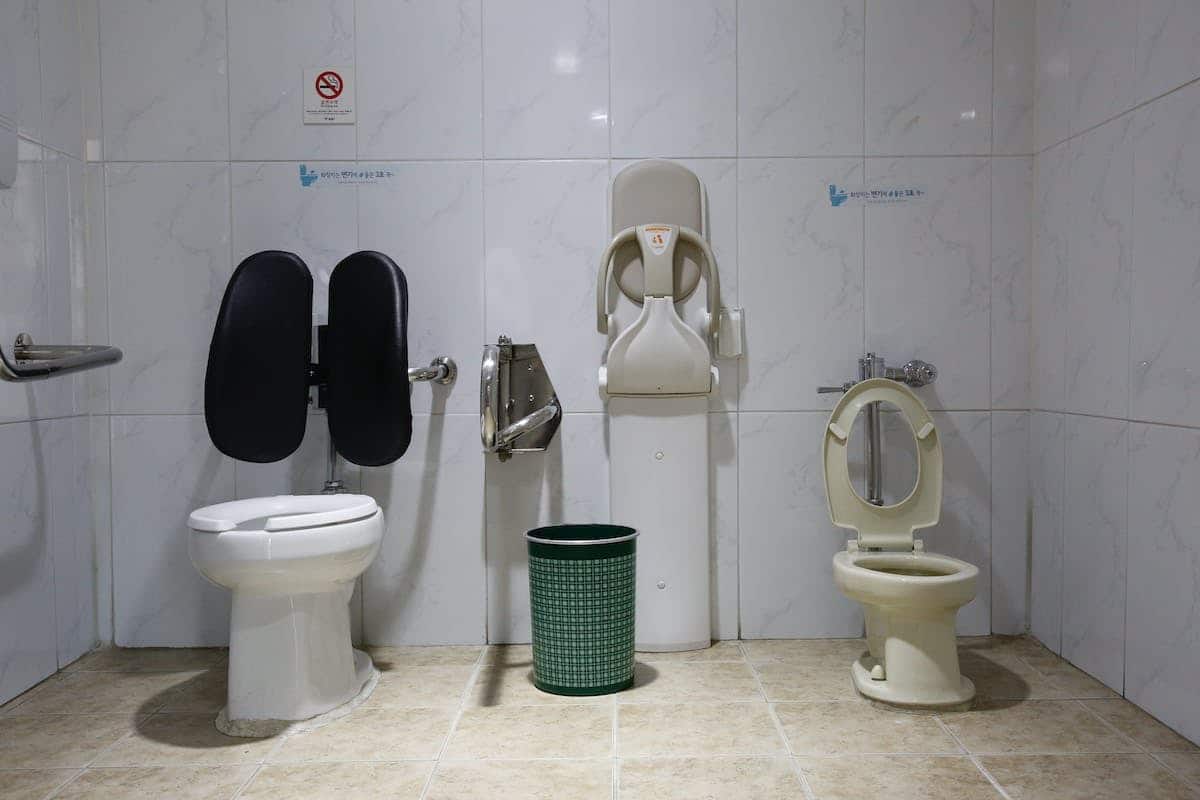
Another crucial point concerns the interior layout of the toilets. The standard now requires that each space be equipped with a side grab bar fixed to the wall at a height between 70 and 75 centimeters. Furthermore, a second foldable grab bar is also required near the sink.
Regarding access to toilets in public buildings under this new PMR toilet standard 2021: it is essential that there is at least one space reserved for disabled persons for every twenty-five available seating places in each room or area typically accessible to the public, such as train stations, airports, or shopping centers.
Lighting is also taken into account in this update of the ‘PMR toilet standard’. It is necessary to equip these adapted sanitary facilities with appropriate lighting providing optimal visibility to facilitate their use by individuals with partial or total visual impairment.
Thanks to all these adjustments made by the regulation, the ‘PMR toilet standard’ has been developed, thus working towards universal access to public and private infrastructures for all persons with disabilities.
Accessibility: Key Changes to Remember
The new PMR toilet standards 2021 bring considerable benefits for disabled individuals. These rules allow for better social inclusion by providing equitable access to public and private infrastructures. Thanks to accessible toilets, individuals with disabilities can now move around more easily and actively participate in daily life.
Another major advantage is the gain in autonomy that accessibility to PMR toilets provides under the new regulations. With a sufficiently spacious, comfortable area equipped with appropriate grab bars, individuals in wheelchairs or with mobility difficulties can attend to their needs with dignity and without external assistance.
These new PMR toilet standards also promote the improvement of health and well-being for the individuals concerned. Indeed, by adhering to certain requirements such as the height of the toilet seat or the appropriate lighting in these sanitary spaces reserved for PMR, the risks of falls or potential accidents during transfers or movements related to toilet use are reduced.
Making public places accessible also demonstrates a significant consideration for equal opportunities for all. This reinforces the feeling of inclusion and thus contributes to creating a fairer society where every individual can fully exercise their fundamental rights.
It is also essential to consider other populations such as the elderly or those with temporary mobility issues. This reflects a genuine concern for consideration and anticipation of the diverse needs of all citizens.
The new PMR toilet standards 2021 represent a real advancement in the field of accessibility for disabled individuals. They ensure equitable access to sanitary infrastructures and thus offer better social inclusion, greater autonomy, improving the health and well-being of the individuals concerned. They contribute to promoting equal opportunities and the creation of a society inclusive for all.
Disability: The Benefits of Accessibility
Looking at the prospects for 2020-2021, it is clear that the accessibility of PMR toilets will continue to evolve. The new PMR toilet standards in force are the result of meticulous and thoughtful work, but this does not mean that their development stops here.
In terms of architectural design and the construction of public and private buildings, we can expect stricter application of the rules regarding accessibility. The competent authorities will certainly strengthen controls to ensure that all infrastructures fully comply with these standards. This will allow disabled individuals to fully benefit from adapted sanitary facilities.
We can anticipate technological advancements in this area. Many companies are looking into developing innovative technologies to make PMR toilets even more accessible. Automated systems may be considered to facilitate the use of the facility by everyone, without distinction.
The role of organizations and associations representing disabled persons will also be crucial in the effective implementation of these new standards. Their ongoing advocacy will help raise societal awareness of this essential cause and encourage real positive change.
It is important to highlight the gradual evolution of mindsets surrounding disability. An inclusive society requires not only accessible physical infrastructure but also a heightened general understanding of the need for social inclusion for all its members.
With the advent of the new standards concerning PMR toilets, we can envision a promising future in terms of accessibility for disabled individuals. The ongoing efforts of authorities, businesses, and organizations advocating for the rights of disabled persons are creating a more inclusive environment where everyone can fully participate in social life. Technological evolution will only enhance this already positive reality by offering new opportunities to ensure ever-greater accessibility.
2020-2021: What Prospects for Accessibility
Regarding commercial establishments, it should be noted that the additional initial cost associated with the installation of accessible sanitary facilities will be offset by the socio-economic benefits it will provide to users and society.
Education also plays a crucial role in this dynamic of social inclusion. Raising awareness among younger generations from an early age will help build a future society where accessibility is not simply perceived as an option, but as a fundamental necessity for all individuals.
It should be mentioned that these new PMR toilet standards are not limited solely to public or commercial buildings. Private residences must also take these measures into account to offer adapted sanitary facilities for disabled persons living in or visiting their homes.
Overall, we see that the new PMR toilet standards contribute to significant progress in terms of accessibility for disabled individuals. Technological advancements, strengthened legal controls, and evolving mindsets are all factors that promote a more inclusive society that respects the rights of every individual. By continuing on this path, we are building a future where accessibility will no longer be considered an option, but an essential standard for all.