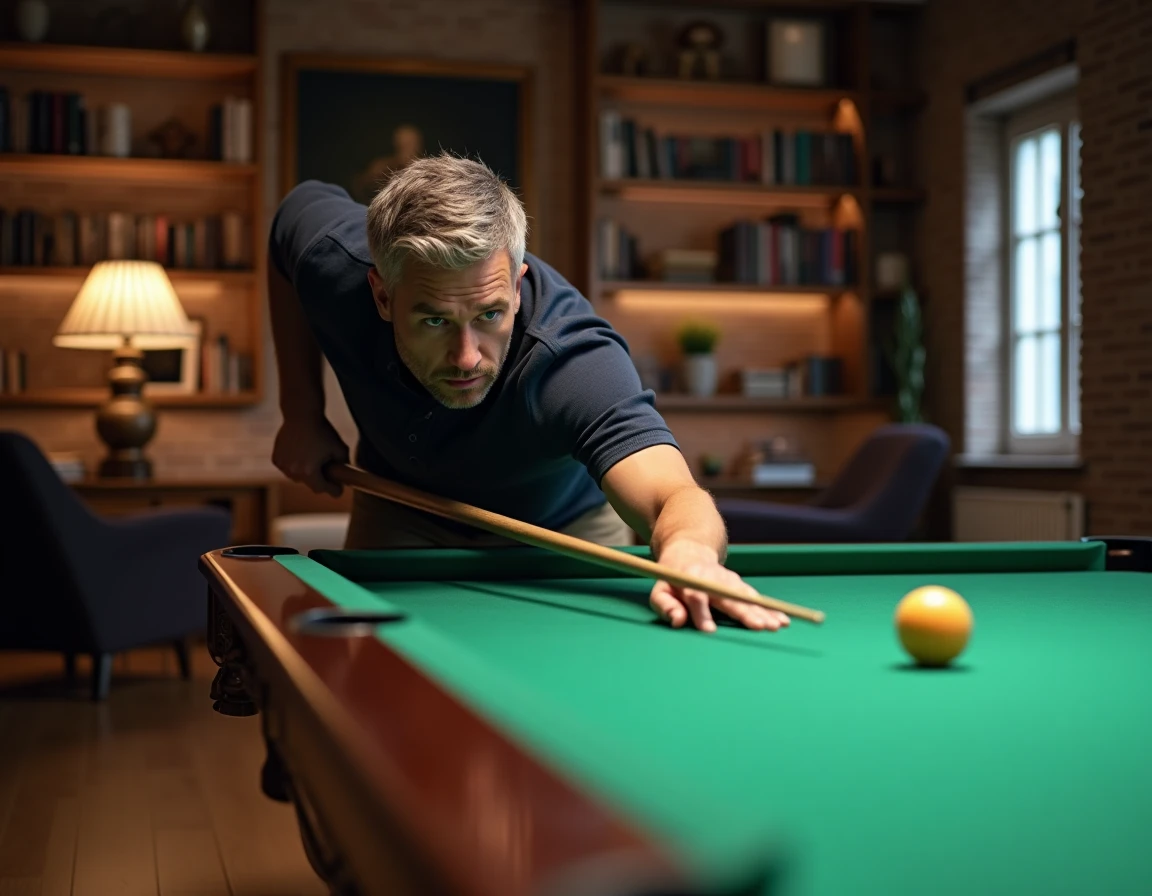
Choosing the size of an American pool table for a living room is like solving an equation between the table size, the length of the cues used, and the actual floor space available. Common sizes (7, 8, and 9 feet) only refer to the playing surface measured between the nose of the rails, not the overall footprint of the furniture. The gap between these two measurements, often overlooked, determines whether the table will fit in the room or not.
Playing Surface, Overall Dimensions, and Clearance Space by Size
Guides often simply provide a size in feet without specifying what that number covers. For a 9-foot American pool table, the standard playing surface measures 2.54 x 1.27 m between the rails. The table itself, including the frame and rails, exceeds these dimensions by several centimeters on each side.
Before any calculations, it is essential to obtain the overall dimensions of the specific model considered from the manufacturer, rather than relying solely on the nominal size.
| Size | Playing Surface (between rails) | Recommended Minimum Room Size (standard cue 1.40 m) |
|---|---|---|
| 7 feet | Approximately 200 x 100 cm | Approximately 4.60 x 3.60 m |
| 8 feet | Approximately 220 x 110 cm | Approximately 4.80 x 3.70 m |
| 9 feet | 254 x 127 cm | Approximately 5.30 x 4.00 m |
The “minimum room” column includes a clearance of about 1.30 m around the table for a standard 1.40 m cue. This clearance is the most restrictive variable: reducing the table size by one format only gains about twenty centimeters per side, while the necessary space to take a shot remains the same as long as the cue does not change.
Find more practical information on Expertise Maison to refine your calculations based on your room’s configuration.
Measure the Free Area of the Living Room, Not Its Total Surface
A living room advertised as 20 m² may turn out to be too narrow if part of the area is occupied by fixed obstacles. Walls are not the only issue.
- A door that opens into the playing area prevents cueing on one side of the table, even if the distance to the wall seems sufficient.
- A non-movable sofa, a load-bearing column, or a staircase drop reduces the actual clearance without this being apparent on a simplified room plan.
- Low furniture (sideboard, console) at elbow height hinders the back arm’s range during rail shots.
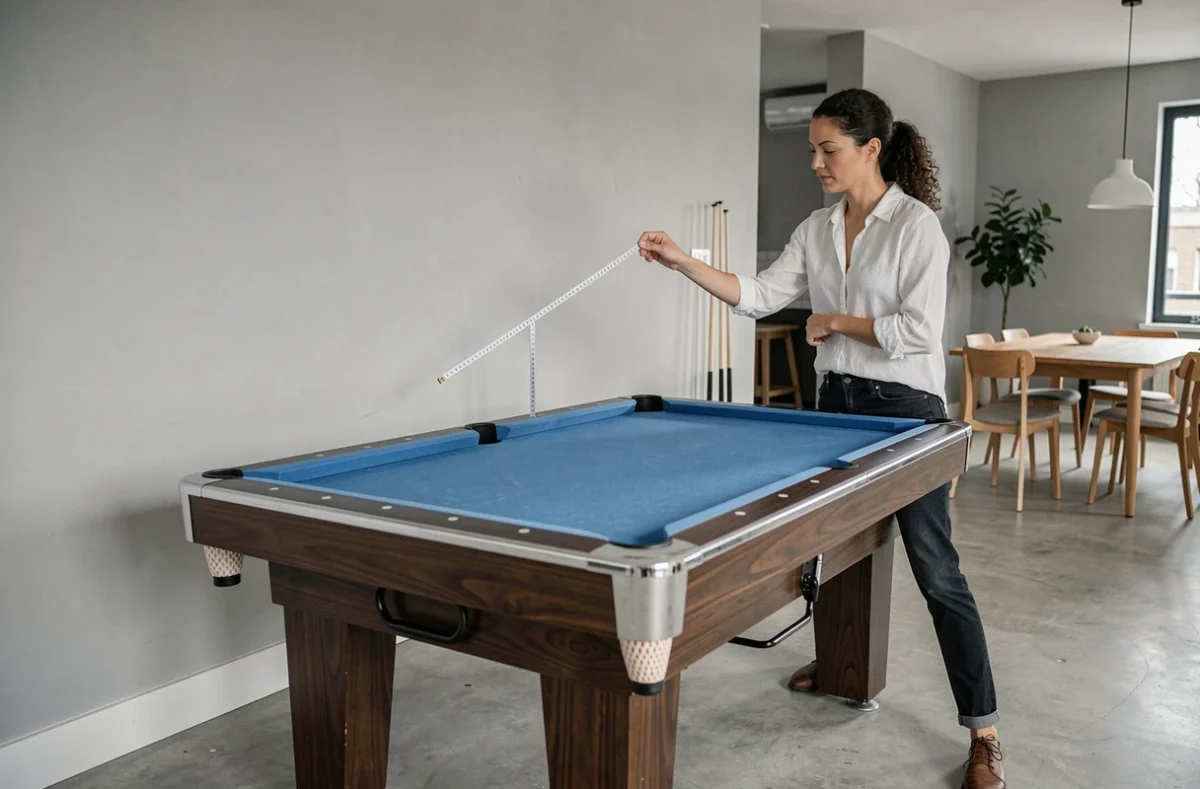
Measure the actually free area, not the total surface of the living room. Mark a rectangle on the floor corresponding to the overall dimensions of the targeted pool table, then check that you have at least 1.30 m of free clearance on each of the four sides. If only one side is constrained, a shortened cue of 48 or 52 inches can compensate temporarily, but this solution is only valid for a single obstacle.
Standard Cue or Short Cue: Impact on Size Choice
The length of the cue directly determines the necessary clearance. A standard American pool cue measures about 1.40 m. Switching to a short cue of 1.20 m reduces the required clearance by about twenty centimeters per side, which may be enough to fit an 8-foot table into a room designed for a 7-foot table.
This reduction has a technical cost. A shorter cue alters the balance and power transmitted to the ball. For a casual player, the difference remains minor. For a regular player who works on their spin, the compromise is felt on long shots and strong backspins.
The short cue helps in a constrained side, but does not replace a suitable room if the lack of clearance affects two sides or more. In this case, downsizing to a smaller table remains the best option.
Access to the Home, an Overlooked Criterion
Before confirming a size, also check the path between the entrance of the home and the destination room. An 8 or 9-foot table is generally delivered disassembled, but the slate top (often in three parts) remains heavy and bulky. Door width, hallway angle, and narrow stairs may require a smaller size or necessitate passing through a window, with additional delivery costs.
Convertible Pool Table: Specific Dimensions and Constraints
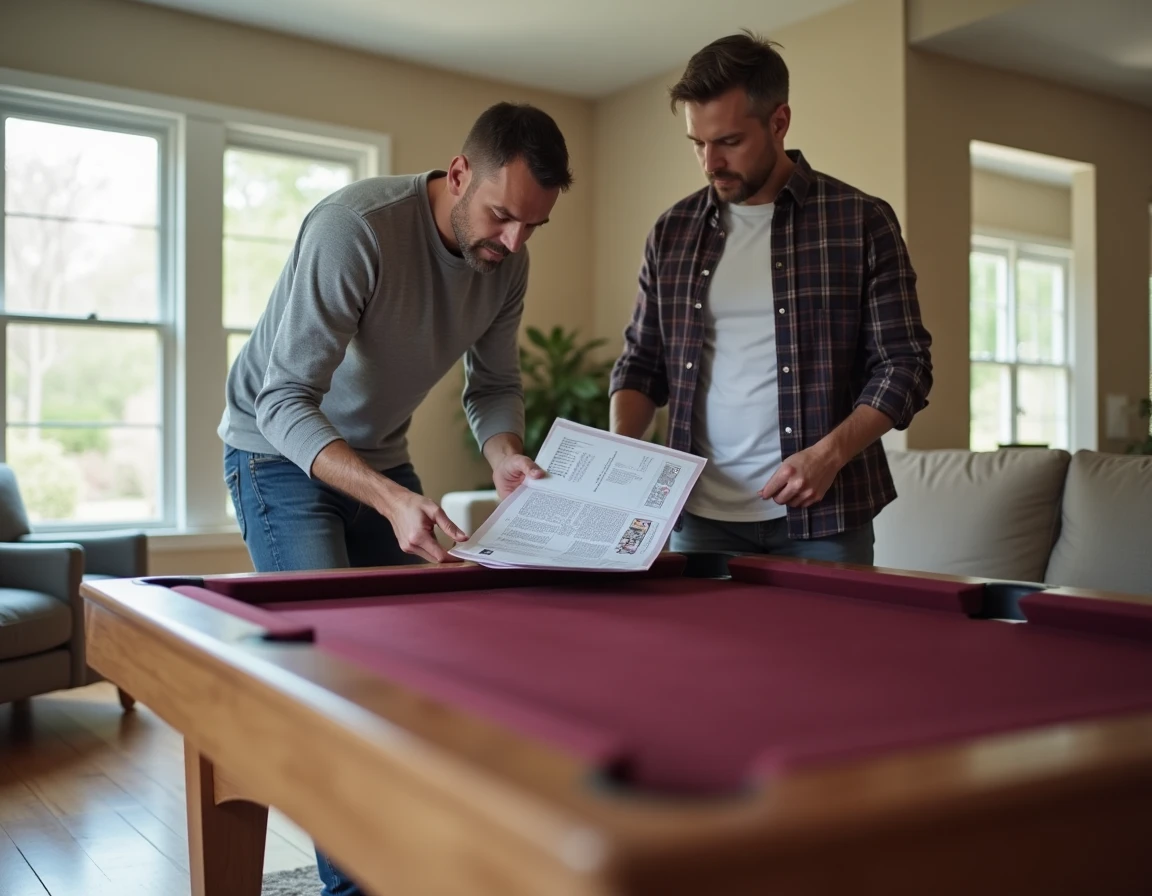
The convertible pool table is appealing in living rooms where the table must also serve daily as a dining table. The conversion top adds a few centimeters in height but does not change the footprint or the clearance needed to play.
A common pitfall is sizing the room for “dining table” use (60 to 80 cm of clearance is sufficient for chairs) and then discovering that the clearance is insufficient to play with a 1.40 m cue. A convertible pool table requires exactly the same playing space as a classic pool table of the same size.
Another point to check: the weight of the conversion top and its storage. A two-part top takes up space once removed. Plan for vertical storage against a wall, close to the pool table, to avoid transporting it through the house for each game.
Which American Pool Table Size to Favor Based on the Room
The 7-foot size is suitable for standard-sized living rooms where the clearance just reaches the required 1.30 m. The 8-foot size offers better playing comfort without requiring a significantly larger room, provided the free area exceeds 4.80 x 3.70 m. The 9-foot size is reserved for rooms longer than 5 m, typically a dedicated game room or a finished basement.
The 8-foot size represents the best compromise for a spacious living room: it accommodates standard balls and rules of American play while remaining compatible with a living area. The more compact 7-foot size is suitable if the priority is to maintain a functional living room layout on a daily basis.
The deciding factor for the choice is neither the budget nor the aesthetics of the furniture, but the actual distance between the edge of the table and the first obstacle on each of the four sides. If this distance drops below 1.20 m somewhere without the possibility of using a short cue, the size considered is too large for the room.